

Job interviews can feel like a high-stakes guessing game. Most candidates ramble or freeze when asked for real-life examples. Turns out, using the STAR method can actually boost your odds of impressing interviewers by up to 50 percent, according to leading career experts. If you want to turn anxiety into advantage and leave a mark your competitors will envy, there is a simple structure that can completely change how you tell your story.
Table of Contents
- What Is The STAR Format Of Interviewing
- Why Use The STAR Format For Interviews
- STAR Format Interview Tips For Different Careers
- Common Mistakes When Using The STAR Method
Quick Summary
| Takeaway | Explanation |
|---|---|
| Master the STAR Method | Understand and practice the Situation, Task, Action, and Result framework for effective storytelling in interviews. |
| Quantify Results to Impress | Use specific metrics to demonstrate your achievements, making your impact clear to interviewers. |
| Avoid Oversharing | Keep your responses concise and focused on relevant experiences to maintain the interviewer’s attention. |
| Adapt Stories for Each Interview | Listen actively and tailor your examples to match the specific questions and context of the interview. |
| Practice for Confidence | Anticipate behavioral questions and rehearse versatile STAR stories to enhance your interview performance. |
What Is the STAR Format of Interviewing
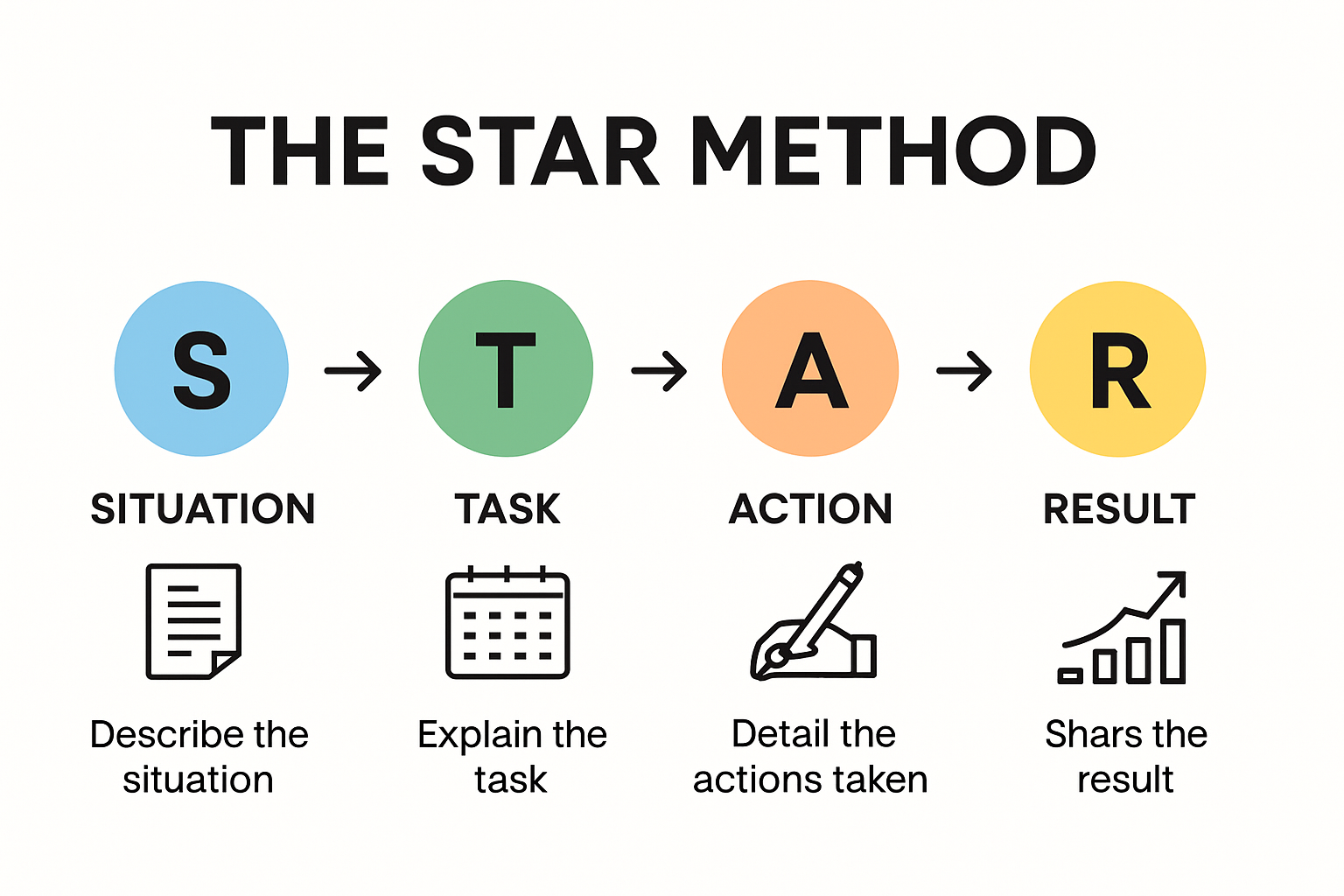
The STAR format of interviewing represents a strategic approach to answering behavioral interview questions that allows candidates to provide structured and compelling responses. This method transforms typical interview interactions by enabling professionals to showcase their skills through clear, concrete examples that demonstrate their problem solving capabilities.
Breaking Down the STAR Method
STAR is an acronym that stands for Situation, Task, Action, and Result. Each component plays a critical role in crafting a comprehensive and impressive interview narrative. According to USAJOBS, this method helps candidates organize their work experiences into meaningful stories that highlight their professional capabilities.
Situation: This initial stage requires you to provide context for the specific scenario you are describing. You must clearly outline the background circumstances that set the stage for your professional challenge. Think of this as painting a precise picture that helps the interviewer understand the exact professional environment you were operating within.
Task: In this segment, you explain your specific responsibility or the challenge you needed to address. This is where you clarify your role and the expectations placed upon you. The task description should be specific and demonstrate your understanding of professional expectations and your personal accountability.
Action: Here you detail the exact steps you took to address the challenge. This is your opportunity to showcase your problem solving skills, strategic thinking, and professional approach. Focus on describing concrete actions you personally implemented, emphasizing your individual contributions and decision making process.
Result: The final component involves explaining the outcomes of your actions. Quantifiable results are particularly powerful. Discuss specific achievements, improvements, or positive changes that emerged from your intervention. Whenever possible, use numbers or percentages to validate your impact.
Below is a table summarizing the STAR method’s components as described above to help clarify each stage’s focus:
Each part of the STAR method serves a unique role in structured interview storytelling:
| STAR Component | Purpose | Example Focus |
|---|---|---|
| Situation | Set the context and background | Describe the professional setting or problem |
| Task | Explain your specific role or challenge | Clarify responsibilities or objectives |
| Action | Describe steps you took to address the task | Detail your individual contributions |
| Result | Share the outcomes of your actions | Quantify achievements or positive impact |
Why Employers Value the STAR Method
Employers appreciate the STAR format because it provides a systematic way to evaluate candidates beyond generic responses. By requiring specific examples, this method helps interviewers assess a candidate’s actual workplace performance, critical thinking skills, and potential cultural fit.
Research from career development experts indicates that candidates who master the STAR format are significantly more likely to make a memorable impression during interviews. The structured approach allows professionals to transform potentially vague discussions into compelling narratives that highlight their unique professional strengths.
Mastering the STAR format requires practice and preparation. Professionals should anticipate potential behavioral questions and develop several versatile stories that can be adapted to different interview scenarios. By preparing concrete examples that showcase problem solving, leadership, teamwork, and adaptability, candidates can confidently navigate even the most challenging interview conversations.
Learn more about advanced interview preparation strategies to complement your STAR method skills and maximize your professional opportunities.
Why Use the STAR Format for Interviews
Professionals seeking to excel in job interviews need a strategic approach that transforms generic conversations into powerful demonstrations of their capabilities. The STAR format provides an unparalleled method for communicating professional experiences with precision and impact.
Demonstrating Professional Competence
According to UC Berkeley’s Career Center, the STAR method is a proven technique for articulating complex professional scenarios in a structured manner. By systematically breaking down work experiences, candidates can effectively showcase their problem solving skills, leadership potential, and adaptability.
Employers are not just looking for someone who can list job responsibilities. They want to understand how a candidate thinks, acts, and creates value. The STAR format allows professionals to move beyond surface level descriptions and provide deep insights into their professional capabilities. When you use this method, you transform a standard interview question into an opportunity to tell a compelling story about your professional journey.
Evidence Based Communication Strategy
Research consistently demonstrates that storytelling is a powerful communication tool. Career development experts from Indeed suggest that structured narrative responses help interviewers better assess a candidate’s potential. The STAR method creates a framework that enables candidates to present concrete evidence of their skills rather than relying on abstract claims.
By organizing responses around specific situations, tasks, actions, and results, professionals can:
- Provide Clear Context: Eliminate ambiguity about your professional experiences
- Highlight Problem Solving Skills: Demonstrate your approach to workplace challenges
- Quantify Professional Impact: Use specific outcomes to validate your contributions
- Create Memorable Impressions: Stand out from candidates who offer generic responses
Strategic Interview Performance
Successful interviews are not about reciting a resume but about creating a narrative that resonates with potential employers. The STAR format equips professionals with a strategic communication approach that transforms interview interactions.
Practicing this method allows candidates to anticipate behavioral questions and prepare compelling stories that highlight their unique strengths. Whether you are discussing a challenging project, a team collaboration, or a personal achievement, the STAR format provides a reliable template for presenting your professional experiences.
Mastering the STAR method is more than a technique it is a comprehensive approach to professional storytelling that can significantly improve your chances of interview success.
STAR Format Interview Tips for Different Careers
The STAR format is a versatile interviewing technique that transcends industry boundaries, offering professionals across various career paths a powerful method to communicate their experiences effectively. While the core principles remain consistent, different career fields require nuanced approaches to maximize the impact of STAR responses.
Tailoring STAR Responses Across Professional Sectors
According to the National Careers Service, the fundamental structure of STAR remains consistent, but the specific content and emphasis can vary dramatically across different professional domains. Tech professionals might focus on problem solving and innovation, while healthcare workers emphasize patient care and teamwork, and sales professionals highlight results and interpersonal skills.
In technical fields like software engineering, candidates should prioritize detailed action steps that demonstrate technical prowess. For instance, when describing a challenging project, elaborate on specific programming languages, problem solving approaches, and technical innovations implemented. Quantitative results become crucial highlighting metrics such as performance improvements, code efficiency, or system optimizations.
Below is a comparison table demonstrating how professionals in different fields can tailor STAR responses to align with key sector expectations:
This table outlines example priorities and emphases for tailoring STAR method answers in various career sectors:
| Career Sector | STAR Focus Area | Example Emphasis |
|---|---|---|
| Software Engineering | Technical solutions, innovation | Coding skills, efficiency gains |
| Healthcare | Patient care, teamwork | Collaboration, positive outcomes |
| Sales | Results, interpersonal skills | Revenue growth, client relations |
| Design / Marketing | Creativity, process, storytelling | Innovation, campaign results |
| Finance / Consulting | Analytical skills, measurable outcomes | Risk management, ROI |
| Public Health/Research | Collaboration, ethical impact | Societal benefit, methodology |
Strategic Approach for Specialized Career Paths
Georgetown University’s Career Center introduces an expanded SOART method that adds an additional layer of depth to traditional STAR responses. This approach includes an extra step of articulating the Takeaway or lesson learned, which becomes particularly powerful in fields requiring continuous learning and adaptation.
For public health and scientific research professionals, NYU School of Global Public Health recommends emphasizing collaborative efforts, ethical considerations, and broader impact. When describing research projects, candidates should highlight interdisciplinary collaboration, methodological rigor, and potential societal implications of their work.
Adapting STAR for Different Professional Levels
Entry level candidates should focus on academic projects, internships, and demonstrable skills, while mid career professionals can draw from a broader range of workplace experiences. Executive level candidates need to emphasize strategic thinking, leadership, and organizational impact.
For creative industries like design or marketing, storytelling becomes paramount. Describe not just the technical steps, but the creative process, innovative thinking, and the emotional journey of solving complex challenges. Showcase how your unique approach generated exceptional results.
Financial and consulting professionals should emphasize analytical skills, risk management, and measurable outcomes. Use specific financial metrics, discuss complex problem solving scenarios, and demonstrate your ability to drive strategic decision making.
Explore personalized interview coaching strategies to refine your STAR method approach and develop interview techniques tailored to your specific career trajectory. Each professional journey is unique, and mastering the STAR format requires understanding both universal communication principles and the nuanced expectations of your specific industry.
Common Mistakes When Using the STAR Method
Mastering the STAR method requires more than understanding its basic structure. Many professionals inadvertently sabotage their interview performance by making critical errors that undermine the effectiveness of their responses. Recognizing and avoiding these common pitfalls can significantly improve your interview success.
Oversharing and Lack of Precision
According to the University of Washington, one of the most significant mistakes candidates make is providing overly detailed or rambling responses. The STAR method demands concise, focused storytelling that highlights your most impactful professional moments.
Interviewers typically allocate limited time for each question. Candidates who spend excessive time describing irrelevant details risk losing the interviewer’s attention and diluting their core message. The key is to be strategic select the most compelling aspects of your experience that directly address the specific interview question.
Effective STAR responses should be like a well edited movie trailer. You want to capture the essence of your professional achievement, showcase your skills, and leave the interviewer wanting to know more about your capabilities.
Neglecting the Result and Failing to Quantify Achievements
Many professionals focus extensively on the Situation and Action components but fall short when articulating the Result. Research from career development experts emphasizes that quantifiable outcomes are crucial for creating a lasting impression.
When describing results, avoid vague statements like “the project was successful.” Instead, provide specific metrics that demonstrate your tangible impact. For example:
- Precise Numerical Outcomes: “Increased team productivity by 35%”
- Financial Impact: “Reduced operational costs by $50,000 annually”
- Efficiency Improvements: “Streamlined process reduced project completion time by 2 weeks”
These specific, measurable results transform your response from a generic narrative to a powerful demonstration of your professional capabilities.
The table below summarizes common STAR method interview mistakes and tips for avoiding them:
Refer to this checklist to ensure your STAR responses avoid the most frequent pitfalls:
| Common Mistake | Description | Tip to Avoid |
|---|---|---|
| Oversharing irrelevant details | Rambling or unfocused answers | Be concise and strategic |
| Neglecting quantifiable results | Failing to use metrics or specific outcomes | Include numbers/percentages |
| Not tailoring response to the question | Using generic or unrelated stories | Actively listen and adapt |
| Lack of focus on your contributions | Speaking too generally about teams or processes | Highlight your specific actions |
Lack of Active Listening and Relevance
Augustana College’s career experts highlight the critical importance of active listening during interviews. Many candidates prepare standard stories in advance and attempt to force them into every question, regardless of relevance.
Successful STAR method implementation requires genuine adaptability. This means:
- Carefully listening to the specific nuances of each interview question
- Being prepared to modify your prepared stories to match the exact context
- Demonstrating flexibility in your professional storytelling
Interviewers are not just evaluating your past experiences but assessing your ability to think critically, communicate effectively, and adapt to different scenarios.
Discover personalized interview preparation techniques to help you navigate these common pitfalls and develop a refined, impactful interview approach. Remember, the STAR method is a skill that improves with deliberate practice and self reflection.

Frequently Asked Questions
What is the STAR format of interviewing?
The STAR format is a structured approach for answering behavioral interview questions. It stands for Situation, Task, Action, and Result, allowing candidates to provide clear and compelling examples of their past professional experiences.
How can the STAR method improve my interview performance?
Using the STAR method can significantly enhance your interview performance by helping you organize your thoughts and articulate your experiences effectively. It can boost your chances of making a memorable impression by up to 50% according to career experts.
What are common mistakes to avoid when using the STAR method?
Common mistakes include oversharing irrelevant details, neglecting to quantify results, and failing to tailor your responses to the specific interview questions. It’s important to be concise, focused, and relevant in your answers.
Why do employers value the STAR method?
Employers appreciate the STAR method because it provides specific examples that demonstrate a candidate’s skills and problem-solving abilities. It allows interviewers to evaluate candidates based on concrete evidence rather than generic claims.
Start Turning Your STAR Stories Into Real Job Offers
Are you tired of struggling with interview answers that never land? You read about the STAR method, but translating your unique experience into powerful responses can feel overwhelming. If you keep missing out on roles you know you deserve, it is time to bridge the gap between understanding the STAR approach and actually standing out in interviews. Our coaching does more than teach you a formula. We show you how to personalize your answers, quantify your results, and present your achievements in ways that resonate with employers who want proof, not promises.
If you want to master the STAR method, conquer interview anxiety, and get personal feedback on your responses, take action now. Visit Rezound Career Coaching to book a personalized session or check out our Interview Coaching page. Competition is fierce. Make sure your next interview is the one that gets you hired.
Recommended
- Home – Rezound Career Coaching
- Powerful Career Transition Coach for Real Change
- Student Career Coaching – Rezound Career Coaching
- How to Pitch Ideas in 2025: A Guide for Aspiring Founders
- Standard Essay Format Guide for 2025: Structure, Tips, and Examples


