

You just started your first real job out of college, and everyone keeps saying how impressed they are with your work. So why do you feel like you’re one Google search away from being exposed as a complete fraud?
Maybe you’re the new hire who nods confidently in meetings while frantically taking notes about terms you’ve never heard before. Or you’re the recent graduate who got hired for your “expertise” in a software you’ve only used in one class project. Perhaps your manager just complimented your analysis, but you’re convinced it was mostly luck and that one really good YouTube tutorial you found.
You keep waiting for someone to tap you on the shoulder and say, “We’ve made a terrible mistake.”
If any of this sounds familiar, welcome to the club—though it’s probably not one you wanted to join.
Feeling like a fraud at work or school is far more common than you might think. Nearly 70 percent of people experience imposter syndrome at some point in their lives. Most people silently battle this self-doubt, expecting it to fade as they rack up achievements. The truth is, imposter feelings often hit hardest when you are actually succeeding. So why do the most capable people question themselves the most?Feeling like a fraud at work or school is far more common than you might think.
Table of Contents
- Step 1: Identify Your Imposter Feelings
- Step 2: Challenge Negative Thoughts
- Step 3: Set Achievable Goals
- Step 4: Seek Support From Peers and Mentors
- Step 5: Reflect and Celebrate Your Accomplishments
Quick Summary
| Key Point | Explanation |
| 1. Recognize Imposter Feelings | Identify self-doubt patterns that undermine confidence and acknowledge their presence in your life. |
| 2. Challenge Negative Thoughts | Use techniques to reframe destructive thoughts and replace them with evidence-based self-perception. |
| 3. Set SMART Goals | Create specific, measurable, achievable, relevant, and time-bound goals to build self-efficacy and reduce overwhelm. |
| 4. Seek Support from Peers | Build a network of mentors and peers who validate your experiences and provide constructive feedback. |
| 5. Reflect and Celebrate Achievements | Maintain a portfolio of accomplishments and regularly review them to reinforce your self-worth and combat self-doubt. |
Step 1: Identify Your Imposter Feelings
Overcoming imposter syndrome starts with recognizing its subtle yet powerful presence in your professional and personal life. Many high achievers struggle with persistent self-doubt without realizing they are experiencing a common psychological pattern that undermines their confidence and potential.
According to research from the University of Alabama Counseling Center, identifying imposter feelings requires honest self-reflection and a willingness to acknowledge your internal narrative. These feelings often manifest as an persistent belief that you are not as competent as others perceive you to be, despite substantial evidence of your skills and achievements.
Key Signs of Imposter Syndrome
Recognizing imposter syndrome involves understanding its characteristic thoughts and emotional patterns. You might experience these feelings if you:
- Constantly downplay your accomplishments
- Feel like you have fooled others into believing you are more capable than you are
- Attribute your success to external factors like luck or timing
- Experience intense anxiety about being “discovered” as inadequate
- Struggle to internalize your achievements
To effectively identify your imposter feelings, start by keeping a thought journal. Document moments when you feel unworthy, underqualified, or anxious about your abilities. Look for recurring patterns in your self-talk and emotional responses. Are you quick to dismiss compliments? Do you hesitate to apply for opportunities because you believe you are not good enough?
Pay special attention to situations that trigger these feelings. Professional presentations, job interviews, performance reviews, and collaborative projects often expose imposter syndrome symptoms. By tracking these instances, you create a map of your internal barriers and begin understanding the root of your self-doubt.
Below is a table summarizing common signs of imposter syndrome to provide a quick reference for recognizing these patterns in yourself or others.
| Sign of Imposter Syndrome | Description |
| Downplaying accomplishments | Consistently minimizing or dismissing personal achievements |
| Feeling like a fraud | Belief that success is due to deceiving others about your abilities |
| Attributing success to external factors | Viewing achievements as a result of luck or timing, not skill |
| Anxiety about being “discovered” | Persistent worry that others will find out you are unqualified |
| Difficulty internalizing achievements | Struggle to accept or embrace personal successes |
Remember that identifying imposter feelings is not about criticism but about developing self-awareness. These feelings do not define your worth or potential. They are simply thought patterns that can be recognized, understood, and ultimately transformed. The goal is to approach these feelings with compassion and curiosity, seeing them as opportunities for personal growth and self-discovery.
Step 2: Challenge Negative Thoughts
Challenging negative thoughts is a critical step in overcoming imposter syndrome. After identifying your imposter feelings, you must develop strategies to confront and reframe these destructive mental patterns that undermine your confidence and potential.
According to research from the National Library of Medicine, developing emotion regulation skills can significantly reduce imposter syndrome symptoms. The process of challenging negative thoughts requires deliberate practice and a structured approach to transforming your internal dialogue.
Cognitive Reframing Techniques
Start by creating a thought evidence log. When a negative thought emerges, immediately document the specific thought and then gather objective evidence that either supports or contradicts it. For instance, if you think “I’m not qualified for this job,” list your relevant skills, achievements, and past successes that demonstrate your capabilities.
Employ the STOP technique when negative thoughts arise:
- Stop: Pause and recognize the negative thought
- Take a breath: Create mental space between the thought and your reaction
- Observe: Analyze the thought objectively
- Proceed: Choose a rational, constructive response
Practice external validation replacement. Instead of relying solely on internal judgments, seek objective feedback from mentors, colleagues, or supervisors. Professional perspectives can provide balanced insights that counteract your internal critic. Ask trusted individuals to share specific examples of your strengths and accomplishments.
Develop a personal achievement narrative. Create a comprehensive document highlighting your professional journey, including detailed accomplishments, skills acquired, challenges overcome, and positive feedback received. Review this document regularly to reinforce your genuine capabilities and counteract imposter syndrome’s undermining messages.
Remember that challenging negative thoughts is not about achieving perfection but developing a more balanced, realistic self-perception. Each time you successfully interrupt and reframe a negative thought, you build mental resilience and move closer to authentic self-confidence.
This table provides an overview of the main steps to overcome imposter syndrome, summarizing the focus and key outcome for each stage.
| Step | Main Focus | Key Outcome |
| 1. Identify Imposter Feelings | Self-reflection and symptom recognition | Awareness of self-doubt patterns |
| 2. Challenge Negative Thoughts | Cognitive reframing and evidence review | Balanced, realistic self-perception |
| 3. Set Achievable Goals | SMART goal setting and progress tracking | Increased confidence through accomplishment |
| 4. Seek Support from Peers/Mentors | Building a support network | Validation and constructive feedback |
| 5. Reflect & Celebrate Accomplishments | Achievement archiving and self-recognition | Internalized sense of self-worth |
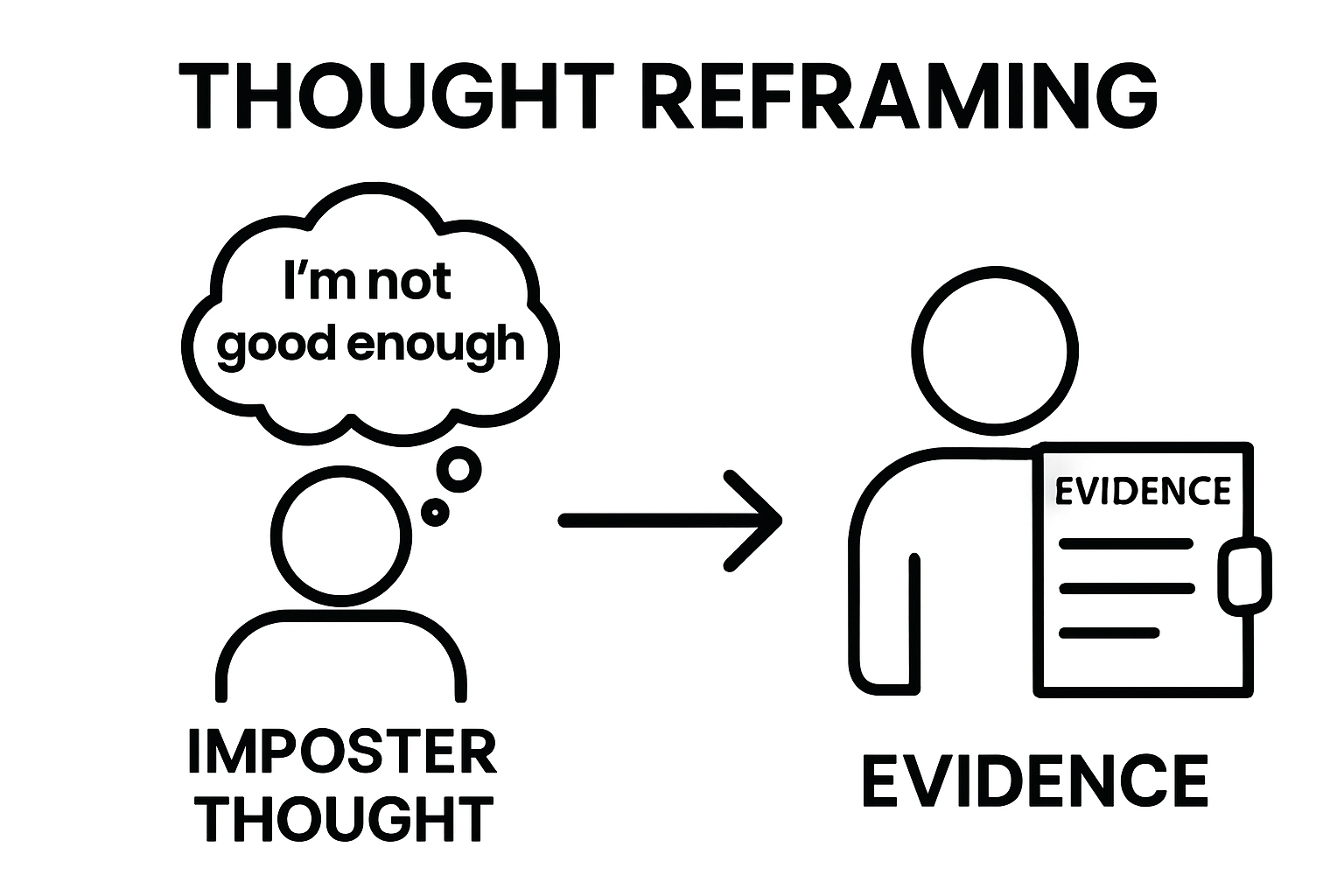
Verify your progress by tracking how frequently you catch and challenge negative thoughts. Over time, you should notice a decrease in their frequency and intensity, replaced by more balanced, supportive self-talk.
Step 3: Set Achievable Goals
Setting achievable goals is a powerful strategy for combating imposter syndrome, transforming self-doubt into structured, actionable progress. When you struggle with feeling like a fraud, creating clear, manageable objectives becomes a practical method to rebuild confidence and demonstrate your true capabilities.
According to research in the International Journal of Behavioral Science, breaking larger tasks into smaller, measurable steps helps individuals with imposter syndrome reduce overwhelm and build self-efficacy. This approach allows you to create a roadmap that validates your skills and gradually dismantles internal barriers.
The SMART Goal Framework
Implement the SMART goal strategy to design objectives that are meaningful and achievable. Each goal should be Specific, Measurable, Achievable, Relevant, and Time-bound. For instance, instead of a vague goal like “improve my skills,” craft a precise objective such as “Complete an online project management certification within the next three months.”
Begin by creating a goal progression journal. Divide your objectives into three categories:
- Short-term goals (1-3 months)
- Medium-term goals (3-12 months)
- Long-term goals (1-3 years)
Each goal should include specific action steps and a mechanism for tracking progress. Utilize digital tools like Trello, Asana, or a simple spreadsheet to monitor your achievements. These platforms help visualize your advancement and provide tangible evidence of your capabilities.
Consider exploring different career path strategies that align with your professional development objectives. By connecting your goals to broader career aspirations, you create a more comprehensive approach to personal growth.
Remember that goal-setting is an iterative process. Regularly review and adjust your objectives, celebrating small wins and learning from challenges. Each completed goal serves as concrete proof of your competence, gradually replacing imposter syndrome’s negative narrative with a confident, evidence-based self-perception.
Verify your progress by maintaining a success log. Document not just the goals you achieve, but also the skills you develop, challenges you overcome, and positive feedback you receive. This ongoing record becomes a powerful testament to your genuine abilities, helping you internalize your worth and potential.
Step 4: Seek Support from Peers and Mentors
Seeking support from peers and mentors is a transformative strategy for overcoming imposter syndrome. By connecting with individuals who understand your professional challenges, you create a supportive ecosystem that validates your experiences and provides constructive guidance.
According to research in the American Journal of Pharmaceutical Education, mentorship plays a crucial role in positively influencing individuals experiencing imposter syndrome by creating open environments and offering constructive feedback.
Building Your Support Network
Start by identifying potential mentors within your professional community. Look for individuals who demonstrate empathy, have achieved success in your field, and show a genuine interest in supporting others. Professional associations, alumni networks, and industry conferences are excellent platforms for discovering mentorship opportunities.
Consider these strategies for developing meaningful professional connections:
- Attend networking events and industry conferences
- Join professional online communities and forums
- Participate in LinkedIn groups related to your career
- Engage in professional development workshops
For students and early career professionals, exploring dedicated student career coaching resources can provide structured guidance in building professional relationships. These platforms often offer targeted mentorship programs designed to support emerging professionals.
When approaching potential mentors, be transparent about your goals and challenges. Share specific areas where you seek guidance, such as skill development, career progression, or managing self-doubt. Prepare thoughtful questions that demonstrate your commitment to personal growth.
Create a mentorship tracking system to document interactions, insights, and action steps. This approach helps you maintain accountability and track your professional development. Use a digital tool like Evernote or a dedicated spreadsheet to record meeting notes, advice received, and personal reflections.
Remember that mentorship is a two-way relationship. Offer value to your mentors by demonstrating active listening, implementing their advice, and providing updates on your progress. Show genuine appreciation for their time and insights.
Verify your progress by assessing the quality of your professional relationships. Effective support networks should leave you feeling more confident, motivated, and equipped to challenge imposter syndrome. Regularly reflect on the guidance received and how it has positively influenced your professional perspective and self-perception.
Step 5: Reflect and Celebrate Your Accomplishments
Reflecting and celebrating your accomplishments is a critical step in overcoming imposter syndrome. This process transforms your internal narrative from self-doubt to self-recognition, helping you internalize your genuine capabilities and professional worth.
According to research from the University of North Carolina’s Heels Care Network, focusing on personal strengths and maintaining a record of skills and experiences can significantly reinforce self-worth and combat imposter syndrome.
Creating Your Achievement Archive
Establish a comprehensive personal achievement portfolio. This digital or physical collection will serve as tangible evidence of your professional growth and capabilities. Include performance reviews, project successes, positive feedback, certifications, and significant milestones. Organize these documents systematically, making them easily accessible for moments of self-reflection.
Develop a structured approach to documenting and celebrating your accomplishments:
- Write detailed monthly reflection journal entries
- Take screenshots of positive email feedback
- Collect performance metrics and achievements
- Save recommendation letters and testimonials
Implement a quarterly achievement review where you intentionally examine your professional journey. During these reviews, analyze your progress, identify growth patterns, and acknowledge the skills you’ve developed. Use this time to challenge negative self-perceptions by presenting objective evidence of your competence.
Create personal celebration rituals that mark your achievements. These don’t need to be elaborate or expensive. Simple acts like treating yourself to a favorite meal, purchasing a small reward, or sharing your success with supportive friends can help reinforce positive self-perception.
Utilize visualization techniques to strengthen your confidence. Create a vision board or digital slideshow that chronicles your professional achievements. Include images, certificates, and written testimonials that represent your journey. Review this visual representation regularly to remind yourself of your genuine capabilities.
Remember that celebrating accomplishments is not about arrogance but about honest self-recognition. Imposter syndrome thrives in environments of self-criticism, so deliberately practicing self-acknowledgment disrupts its negative cycle.
Verify your progress by assessing your emotional response to achievements. Over time, you should notice a shift from dismissing successes to genuinely accepting and appreciating them. Your ability to confidently discuss your accomplishments without qualifying them or diminishing their significance is a clear indicator of overcoming imposter syndrome.

Ready to Replace Self-Doubt with Unshakable Confidence?
If you find yourself constantly downplaying your achievements, second-guessing your capabilities, or struggling to shake off imposter syndrome despite your best efforts, you are not alone. The journey you started with identifying negative thoughts, setting SMART goals, and seeking mentorship is exactly what our expert career and life coaches at Rezound Career specialize in. Your growth does not need to stop with self-reflection. The right support can transform doubt into opportunity and uncertainty into clear purpose.

Let today be the day you take tangible action. Work directly with certified coaches who understand how to help recent graduates and career switchers break the cycle of self-doubt. Get tailored guidance on interview skills using the STAR and PAR methods, sharpen your resume and cover letter, and gain ongoing support for true personal development including accountability and setting boundaries. Visit Rezound Career to learn how coaching can move you from feeling like an outsider to reaching your next milestone with real confidence. Book your first session now and start building the future you deserve.
Frequently Asked Questions
What is imposter syndrome?
Imposter syndrome is a psychological pattern where high achievers doubt their skills and feel like frauds despite evidence of their competence. It often involves attributing success to external factors and feeling like one will be ‘discovered’ as inadequate.
How can I identify if I have imposter syndrome?
You can identify imposter syndrome by recognizing patterns of self-doubt, downplaying achievements, and frequently feeling anxious about being exposed as incompetent. Keeping a thought journal can help track these feelings and identify triggers.
What strategies can I use to challenge negative thoughts related to imposter syndrome?
To challenge negative thoughts, try creating a thought evidence log to document and analyze them. Use techniques like the STOP method (Stop, Take a breath, Observe, Proceed) to create a mental pause and respond constructively.
How do I set achievable goals to combat imposter syndrome?
Set achievable goals using the SMART framework (Specific, Measurable, Achievable, Relevant, Time-bound). Break larger tasks into smaller steps, and maintain a goal progression journal to track your advancements and build confidence.


