

Everyone talks about building a personal brand, but most people never get past a basic LinkedIn update or the occasional post. Turns out, your online presence is only the start. The real difference comes from a unique value proposition that makes you stand out, and fewer than 10 percent of professionals can actually explain theirs clearly. That gap? It’s exactly where the opportunity is hiding.
Table of Contents
- Step 1: Define Your Unique Value Proposition
- Step 2: Establish Consistent Online Presence
- Step 3: Create Engaging Content and Resources
- Step 4: Network Strategically and Build Relationships
- Step 5: Monitor and Adjust Your Brand Strategy
Quick Summary
| Key Point | Explanation |
| 1. Define Your Unique Value Proposition | Identify what sets you apart in your field through skills and experiences. This becomes your professional signature. |
| 2. Establish a Consistent Online Presence | Audit your digital footprint to ensure all profiles reflect your personal brand professionally and cohesively. |
| 3. Create Engaging Content | Share valuable insights that showcase your expertise. Use different formats to appeal to diverse audiences. |
| 4. Network Strategically | Build meaningful relationships through genuine interactions, leveraging professional platforms and events to support mutual growth. |
| 5. Monitor and Adjust Your Brand Strategy | Continuously evaluate your brand’s effectiveness and adapt your strategy to align with your evolving career goals. |
Step 1: Define Your Unique Value Proposition
Building your personal brand starts with understanding what makes you distinctly valuable in your professional landscape. Your unique value proposition is essentially your professional signature – the special combination of skills, experiences, and perspectives that set you apart from everyone else in your field.
To craft a compelling value proposition, begin by conducting a thorough self-assessment. This isn’t just about listing your skills but diving deep into what truly differentiates you. Consider your professional experiences, academic background, unique problem solving approaches, and the specific challenges you solve exceptionally well. Think about moments in your career or education where you demonstrated extraordinary capabilities that others might find challenging.
Reflect on feedback you’ve received throughout your academic and professional journey. What do colleagues, professors, or managers consistently praise you for? These repeated observations often highlight your most distinctive strengths. Perhaps you have a remarkable ability to simplify complex technical concepts, or maybe you excel at bridging communication gaps between different teams. These nuanced capabilities become key components of your personal brand.
Start drafting a concise statement that captures your unique value. According to Harvard Business Review, an effective value proposition should be clear, specific, and focused on the outcomes you can deliver. Aim for a statement that answers three critical questions: What do you do? Who do you do it for? What makes your approach different?
For example, instead of saying “I’m a software developer,” you might say “I help mid sized tech companies streamline their software development processes by implementing innovative agile methodologies that reduce project timelines by 30%.” This statement immediately communicates your specialty, target audience, and quantifiable impact.
Validate your value proposition by testing it with mentors, professional peers, or career coaches. Their external perspective can help refine your narrative and ensure it resonates with potential employers or clients. Remember, your unique value proposition is not a static document but a dynamic description that will evolve as your career progresses.
Step 2: Establish Consistent Online Presence
After defining your unique value proposition, the next critical step in building your personal brand is establishing a consistent and professional online presence. In today’s digital world, your online profile often serves as the first impression for potential employers, clients, and professional connections.
Start by auditing your current digital footprint. Google yourself and review what potential employers might see when they search your name. Clean up any unprofessional social media content, inappropriate photos, or outdated profiles that do not align with your professional image. According to LinkedIn’s Talent Solutions Report, 92% of recruiters use social media for screening candidates, making your online reputation crucial.
Prioritize creating or optimizing your LinkedIn profile as your primary professional networking platform. Ensure your profile photo is high quality, professional, and represents your personal brand. Write a compelling headline that goes beyond your job title and incorporates your unique value proposition. Your summary should tell a story that highlights your professional journey, key achievements, and the specific value you bring to potential employers or clients.
Expand your online presence strategically across platforms relevant to your industry. For professionals in creative fields, this might mean maintaining a robust Behance or Dribbble portfolio. Tech professionals might contribute to GitHub repositories or write technical blogs. Academic and research professionals could maintain profiles on ResearchGate or publish on professional academic platforms.
Consider creating a personal website or professional blog that showcases your expertise. This platform allows you to demonstrate thought leadership, share insights specific to your industry, and provide a comprehensive view of your professional capabilities. Use consistent branding elements like color schemes, fonts, and professional imagery across all your online platforms to create a cohesive personal brand identity.
Here is an overview table summarizing online platforms you can use to strengthen your personal brand, along with their primary purpose and the type of professionals who benefit most.
| Platform | Primary Purpose | Best For |
| Professional networking/profile hub | All professionals | |
| Personal Website | Showcasing expertise, thought leadership | Most fields |
| Behance | Portfolio for creative work | Designers, creative roles |
| Dribbble | Sharing and discovering creative portfolios | Designers, illustrators |
| GitHub | Sharing coding projects and repositories | Software/tech professionals |
| ResearchGate | Academic profiles and research sharing | Researchers, academics |
Regularly update your online profiles with recent achievements, projects, certifications, and professional development activities. Engage meaningfully in professional online communities by commenting, sharing relevant content, and connecting with industry peers. This active participation helps establish your credibility and expands your professional network.
Finally, verify the success of your online presence by conducting periodic self audits. Check that your profiles consistently communicate your unique value proposition, reflect your current professional status, and present a unified, professional image across all platforms.
Step 3: Create Engaging Content and Resources
After establishing your online presence, the next crucial step in building your personal brand is creating meaningful and engaging content that showcases your expertise and unique perspective. Content creation is more than just posting randomly; it’s about strategically sharing insights that demonstrate your professional capabilities and thought leadership.
Begin by identifying the platforms most relevant to your industry where content can have maximum impact. For professionals in technical fields, this might mean writing detailed technical blog posts or creating tutorial videos. Creative professionals could develop portfolio case studies, while academic experts might produce research summaries or scholarly articles. Learn more about selecting the right career path to align your content strategy with your professional goals.
Develop a consistent content strategy that balances original insights with curated industry information. The goal is to position yourself as a knowledgeable contributor, not just a passive observer. According to Content Marketing Institute, professionals who regularly share valuable content are 3x more likely to be perceived as industry thought leaders.
When creating content, focus on solving real problems your target audience experiences. Share practical advice, break down complex concepts, and provide actionable insights drawn from your professional experience. Write in a clear, conversational tone that makes complex information accessible. Use storytelling techniques to make your content more engaging, sharing personal experiences that illustrate professional lessons.
Consider diversifying your content formats to reach different audiences. This might include writing LinkedIn articles, recording short educational videos, creating infographics, participating in podcast interviews, or developing comprehensive guides in your area of expertise. Each format offers a unique way to communicate your professional narrative and demonstrate your depth of knowledge.
Track the performance and engagement of your content to understand what resonates with your audience. Pay attention to comments, shares, and feedback. Use these insights to refine your content strategy, focusing on topics and formats that generate the most interest and interaction.
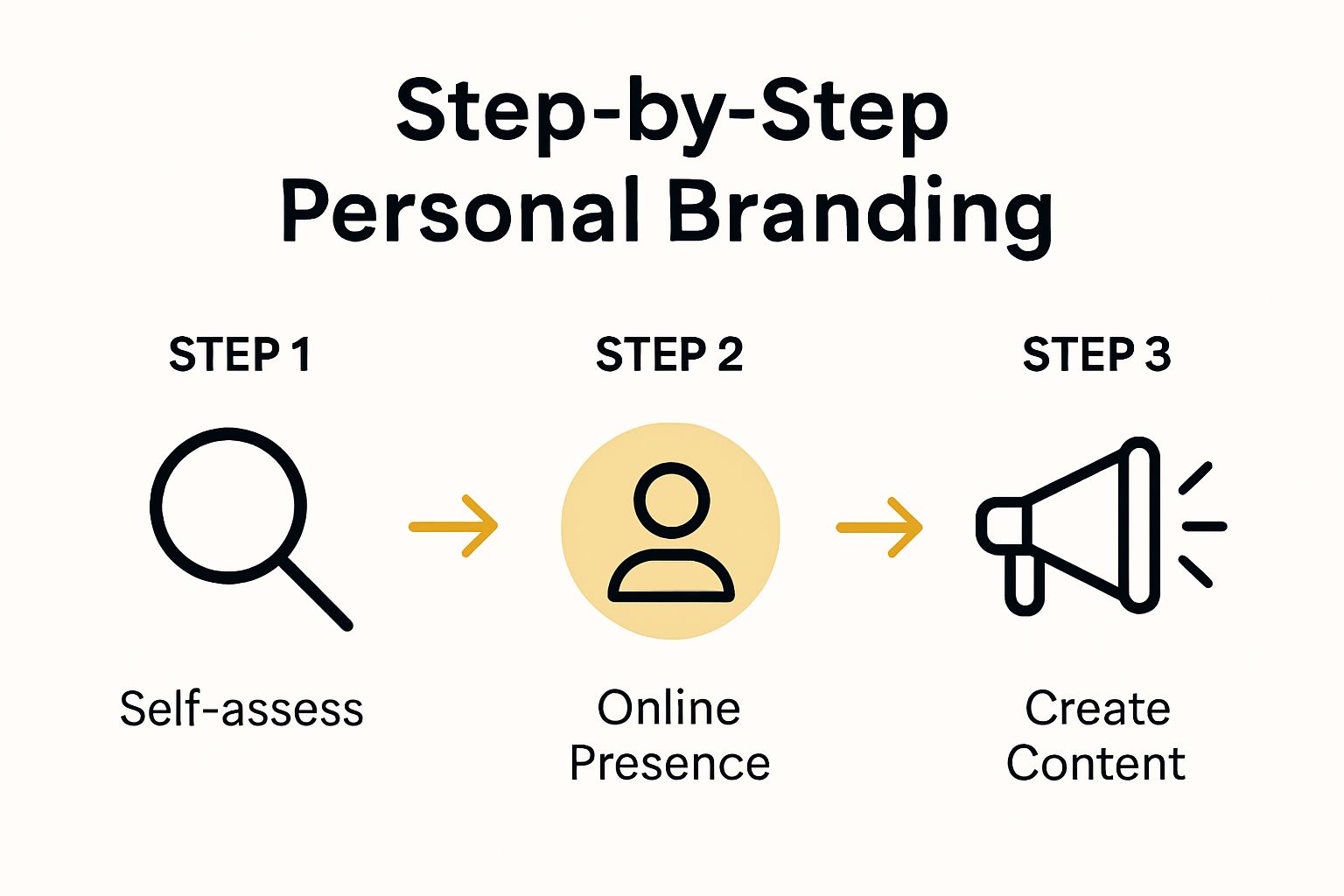 Consistently publishing high quality, relevant content helps establish your credibility and expands your professional network.
Verify the success of your content strategy by monitoring key metrics: engagement rates, follower growth, professional connections made, and opportunities generated through your content. Remember that building a strong personal brand through content is a marathon, not a sprint, requiring patience, consistency, and genuine value creation.
This checklist outlines essential verification steps to ensure your brand-building efforts are on track at each stage.
| Step | Completion Criteria |
| Define Value Proposition | Drafted, tested, and refined value statement |
| Establish Online Presence | Consistent, updated profiles across major channels |
| Create Engaging Content | Regular posts with audience engagement |
| Network Strategically | Meaningful connections and follow-ups |
| Monitor & Adjust Brand | Routine self-reviews and strategy updates |
Step 4: Network Strategically and Build Relationships
Networking is far more than collecting business cards or making superficial connections. It’s about building meaningful professional relationships that can support your career growth and personal brand development. Strategic networking requires intentionality, authenticity, and a genuine commitment to mutual professional growth.
Begin by mapping your existing professional network, including colleagues, former classmates, mentors, and industry acquaintances. Discover strategies for finding your perfect career path that can help you identify the most valuable connections for your professional journey. Reconnect with these contacts through personalized messages that demonstrate genuine interest in their professional experiences.
Leverage professional networking platforms like LinkedIn to expand your connections strategically. Attend virtual and in person industry conferences, webinars, and professional meetups relevant to your field. When approaching new connections, focus on offering value rather than immediately seeking favors. Share interesting insights, provide helpful resources, or offer genuine compliments about their professional achievements.
According to Harvard Business Review, effective networking is about creating mutually beneficial relationships. Develop a practice of making meaningful introductions, sharing professional opportunities, and supporting your network’s goals. This approach transforms networking from a transactional experience into a collaborative professional ecosystem.
Create a systematic approach to relationship building. Set regular reminders to check in with professional contacts, share relevant articles, congratulate them on achievements, or offer support during their career transitions. Engage authentically in online professional communities, contributing thoughtful comments and participating in meaningful discussions that showcase your expertise.
Be intentional about diversifying your network. Seek connections with professionals from different backgrounds, industries, and career stages. Each interaction provides an opportunity to learn, gain fresh perspectives, and expand your understanding of potential career pathways. Remember that powerful networks are built on genuine curiosity, respect, and a willingness to contribute without immediate expectations of return.
Verify the success of your networking efforts by tracking meaningful interactions, professional opportunities generated, and the depth of your professional relationships. A strong network is not measured by the number of connections, but by the quality of interactions and the mutual support shared among professional colleagues.

Step 5: Monitor and Adjust Your Brand Strategy
Building a personal brand is not a one time effort but an ongoing process of continuous refinement and adaptation. Monitoring and adjusting your brand strategy ensures that your professional narrative remains relevant, authentic, and aligned with your career aspirations.
Start by establishing a systematic approach to tracking your personal brand performance. Set up Google Alerts for your name and professional keywords to stay informed about how you are perceived online. Review your social media analytics, content engagement metrics, and professional network growth regularly. According to research from Purdue University, consistent self evaluation is crucial for maintaining an effective personal brand strategy.
Conduct periodic self assessments by soliciting honest feedback from trusted mentors, colleagues, and professional peers. Create a confidential feedback mechanism where people can share candid observations about your professional image, communication style, and perceived strengths. This 360 degree perspective helps identify blind spots and opportunities for improvement that you might not recognize on your own.
Evaluate the alignment between your current professional goals and your existing personal brand strategy. As your career evolves, your unique value proposition may shift. Be prepared to update your professional profiles, content strategy, and networking approach to reflect your growing expertise and changing career objectives. Consider how emerging industry trends and technological changes might influence your professional positioning.
Develop a flexible personal brand roadmap that allows for strategic pivots. This means being open to rebranding certain aspects of your professional identity when necessary. Perhaps you are transitioning between industries, developing new skills, or exploring leadership roles. Your personal brand should be dynamic enough to communicate these professional transformations authentically.
Utilize professional development tools and resources to continuously enhance your brand. Attend workshops, pursue additional certifications, and invest in learning opportunities that expand your professional capabilities. Each new skill and experience provides an opportunity to enrich your personal brand narrative and demonstrate ongoing professional growth.
Verify the effectiveness of your brand strategy by tracking tangible outcomes such as professional opportunities secured, network expansion, content engagement rates, and alignment with your long term career objectives. Remember that a powerful personal brand is not static but a living, breathing representation of your professional journey that evolves alongside your career aspirations.
Ready to Make Your Personal Brand Stand Out and Open New Doors?
Building a personal brand is exciting, but it can also feel overwhelming. Whether you struggle to define your unique value or worry about standing out in today’s tough job market, you are not alone. Many people get stuck trying to create a compelling story and feeling lost in a sea of competition, especially when making a career transition or stepping into a new field. Our Career Coaching services are designed to help you get clarity, confidence, and a clear path forward by applying proven strategies discussed in this guide like using STAR or PAR methods in interviews and refining your value proposition.
Do not let your brand blend in with the crowd. Take charge of your story and rise above the noise. Visit Rezound Career Coaching today. Book a session to receive personalized, expert guidance that will turn each step you read about into real results. The best version of your brand — and your career — is waiting.
Frequently Asked Questions
What is a unique value proposition in personal branding?
A unique value proposition is a clear statement that defines what makes you distinctively valuable in your professional landscape. It includes your skills, experiences, and the specific outcomes you deliver that differentiate you from others in your field.
How can I establish a consistent online presence for my personal brand?
To establish a consistent online presence, audit your current digital footprint, optimize your LinkedIn profile, create a personal website, and engage with professional online communities. Ensure that all your profiles reflect your unique value proposition and present a professional image.
What types of content should I create to enhance my personal brand?
Create meaningful content such as industry-specific blog posts, tutorials, infographics, and videos that showcase your expertise. Focus on solving real problems for your audience and use storytelling techniques to make your content engaging.
How do I effectively network to support my personal brand?
Effective networking involves building meaningful professional relationships rather than just collecting contacts. Focus on offering value, making genuine connections, and staying in touch with your professional contacts to foster mutual support.
Recommended
- Choosing a Career Path: Steps for Every Stage in Life – Rezound Career Coaching
- How Do I Find the Perfect Job for Me: Simple Steps for Success – Rezound Career Coaching
- Top Benefits and Importance of Personal Development
- Understanding Why Personal Development Matters for Growth – Rezound Career Coaching


